
Most lenders accept default rates as an unavoidable cost of doing business. They build sophisticated algorithms to predict losses, adjust pricing accordingly, and move on. But what if the causes of those defaults were actually fixable—just not visible from the lender’s vantage point?
The truth is, the root causes of merchant defaults often have nothing to do with the borrower’s creditworthiness or the inherent risk of an industry. They stem from operational problems at the merchant level: misaligned marketing, poor sales processes, and weak customer communication. These are problems lenders rarely see—but that doesn’t mean they can’t be solved.

The Algorithm Blindness Problem
Financial institutions that factor receivables in the debt industry—tax resolution, debt settlement, student loan consolidation—typically operate on well-established models. They know that a certain percentage of accounts will default, and they price their services accordingly. The algorithm works, so nobody questions it.
But here’s the problem: these models treat default rates as a fixed input rather than a variable that can be improved. It’s like a construction company that accepts one in ten concrete squares will crack, without ever asking why they crack. If you never investigate the cause, you can never fix it.
The merchants you finance—the tax resolution firms, the debt settlement companies—are the ones generating those defaults. And the reasons are often surprisingly fixable: a marketing campaign that overpromises, a sales script that sets wrong expectations, or a lack of communication that causes customers to get cold feet and cancel.
What’s Really Driving Defaults
When we analyze merchant operations, we consistently find that defaults cluster around a few predictable issues.
Marketing-to-Service Disconnect
The messaging in a merchant’s advertising doesn’t always match the actual service experience. Social media ads, in particular, tend to make broad promises to anyone with debt. When customers sign up expecting one thing and receive another, dissatisfaction—and cancellation—follow quickly.
Incomplete ROI Calculations
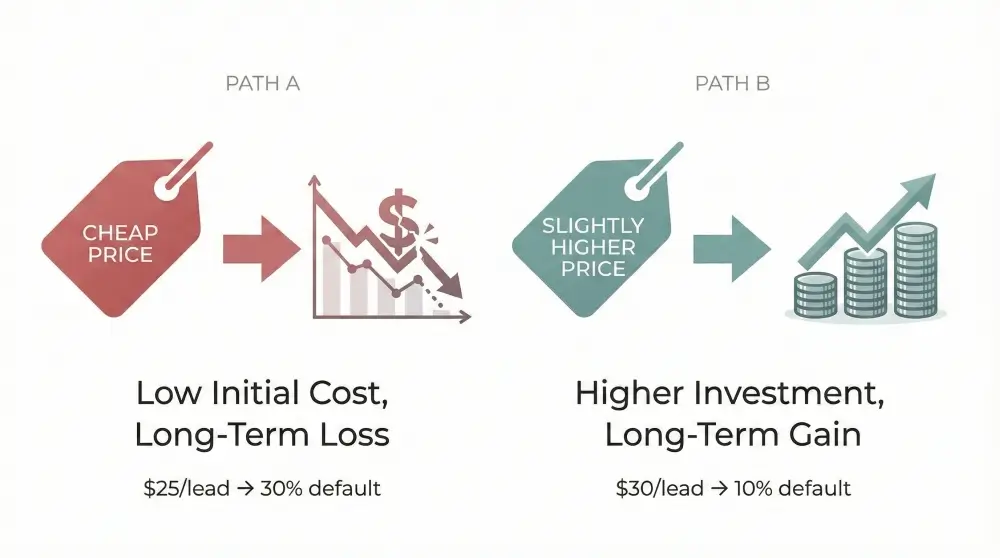
Most merchants evaluate their marketing campaigns on cost-per-acquisition alone. They track how much they spend per lead and how many leads convert to closed deals. What they don’t track is how those deals perform over time—which campaigns produce customers who stick, and which produce customers who default.
Here’s a real-world example: A merchant might celebrate a campaign that costs $25 per lead, while dismissing another campaign at $30 per lead as too expensive. But if the cheaper campaign produces a 30% default rate while the pricier one produces only 10%, the math changes entirely. Factor in clawbacks, fees, and lost revenue, and the “expensive” campaign can actually deliver 7% higher profit margins. On a $10 million portfolio, that’s $700,000 left on the table.
Communication Gaps
Customer apprehension spikes dramatically after just three days of silence. Yet many merchants let new customers go a week or more without any touchpoint. The salesperson moves on to the next deal, the processor waits for paperwork, and the customer—who just made a significant financial decision—starts to doubt whether they made the right choice. That doubt turns into cancellation.
The Case for Investing in Merchant Operations
Traditional lender logic says: if an industry has high default rates, either price for it or avoid it. But there’s a third option—reduce the defaults at the source.
We recently worked with a merchant whose lender was experiencing default rates between 30% and 33%. After implementing operational improvements—refining their marketing targeting, restructuring their sales handoff process, and introducing automated customer touchpoints—that default rate dropped to 11%. That’s a 66% reduction in defaults, directly impacting the lender’s bottom line.
For lenders, this represents a significant opportunity. Rather than competing solely on rates or avoiding certain industries altogether, forward-thinking financial institutions can differentiate themselves by actively improving the performance of their merchant portfolios.
A Different Kind of Partnership
The relationship between lenders and merchants has traditionally been transactional: the lender provides capital, the merchant provides receivables, and both parties hope for the best. But when lenders partner with operations specialists who can identify and fix the root causes of defaults, everyone wins.
Merchants get healthier businesses with better customer retention. Lenders see improved portfolio performance and fewer losses. And customers receive the service they were actually promised.
The defaults you’re experiencing aren’t inevitable. They’re symptoms of problems that can be diagnosed and treated. The question is whether you’re willing to look beyond the algorithm and fix what’s really broken.
Ready to improve your portfolio performance?
Mint Group specializes in operational improvements for merchants in the debt industry—tax resolution, debt settlement, and student loan consolidation. We help lenders reduce defaults by fixing the issues they can’t see from the outside. Contact us to learn how we can help strengthen your merchant relationships and your bottom line.